
From the age of twelve, Juan Pablo began to question everything. He inquired about the existence of inequalities and injustices, wondering why in such a wealthy country there were people eating out of the trash, and why many—including children—were dying due to a lack of medicine and food.
Perhaps it was because, at his young age, he had already been a victim of crime on three occasions and had to face his sister María Gabriela’s battle with cancer.
Today, neither Juan Pablo nor María Gabriela are here; she passed away as a result of the advanced stage of her illness after her brother was murdered.

Our son, Juan Pablo Pernalete, a university student murdered at 20 years old, dedicated his life to pursuing just causes; he was passionate and disciplined. He was a decorated athlete who represented Venezuela in student basketball in Spain, Chile, and Argentina. This earned him a scholarship for athletic excellence to study at the Universidad Metropolitana in Caracas. He was also a Human Rights activist and an active member of the Model United Nations in Venezuela.
He was a young man with a deep conviction for defending the right to express ideas, even when they were contrary to his own. From a young age, despite inequalities and injustices, he always believed that Venezuela could be a better country. Having never known any other government, Juan Pablo firmly believed our country would improve, and that it would be possible to live with dignity. He did not want to leave the country he loved, because his future and his family were here. He was convinced that, as a Venezuelan, he had the right to demonstrate and think differently, to protest, and to be heard.
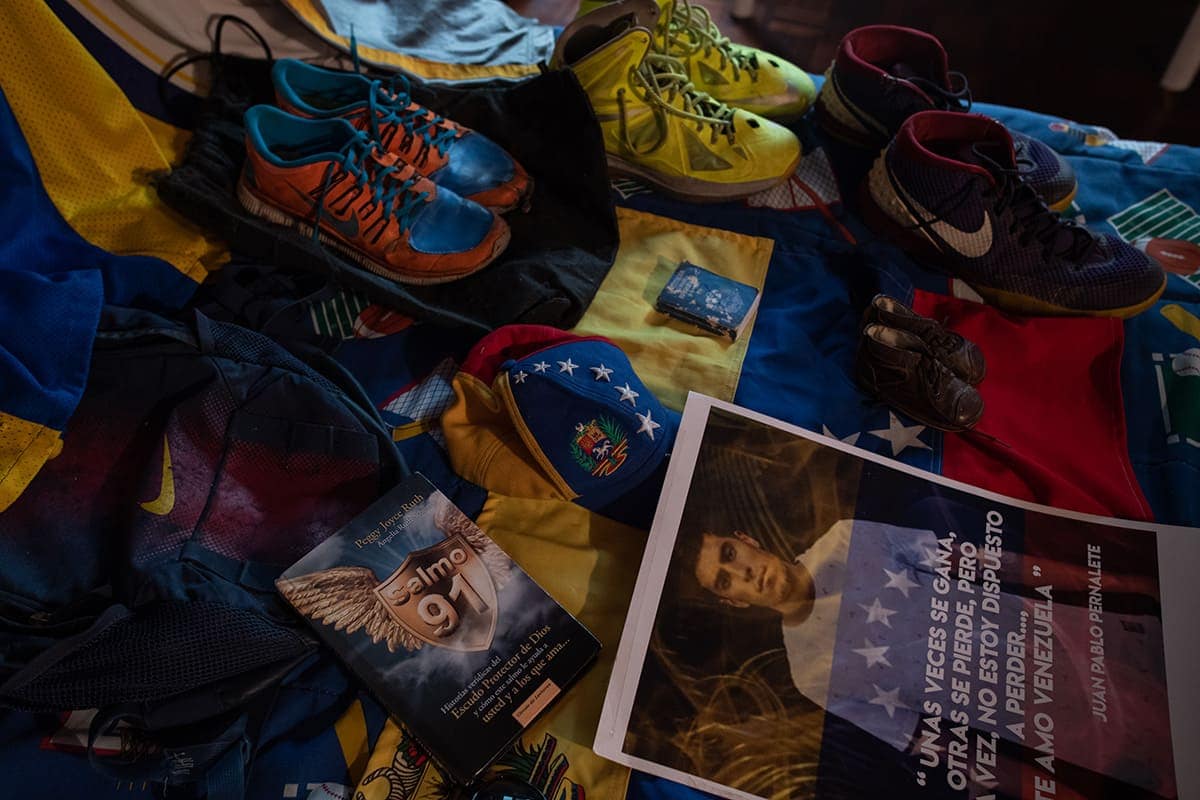
That is why he went out to demonstrate; that is why he fought and lost his life, after a member of the Bolivarian National Guard decided to shoot him.
On April 26, 2017, Juan Pablo was protesting in Altamira when a member of the Bolivarian National Guard fired a tear gas canister directly at his chest—at close range, as if it were a projectile. It impacted his left side and, within minutes, caused death by cardiogenic shock due to a hemorrhagic contusion from blunt chest trauma at the precordial level.
When we found out, we were with our daughter María Gabriela, who had recently undergone surgery for liver cancer; we were buying medicine. At that moment, we began receiving phone calls informing us that our son had been injured in the demonstrations, and we moved to Salud Chacao. When we arrived, they gave us the news that our son was dead.
The Venezuelan regime’s first response was to use all state media to distort the facts, creating a false narrative to divert the investigations. The Venezuelan State mocked us to our faces, claiming that the Bolivarian National Guard was not at the scene and that our son had been murdered by a captive bolt pistol. This caused us immense emotional, psychological, and moral distress.

The process to reveal the truth and achieve justice has been characterized by procedural delay. We are facing a justice system corrupted by a regime that violates human rights—a regime whose strategy has been to wear us down and thus keep those responsible unpunished. They attempt to hide information and distort the facts surrounding the murders of hundreds of young people during the 2017 demonstrations. We face a tainted justice system that tries to exhaust us and make us abandon our search for the truth.
In the midst of this titanic struggle, we decided to found ALFAVIC Venezuela, an organization made up of parents and relatives of the young people murdered during protests. In this way, we began to communicate; initially, we wanted to achieve emotional support and companionship, but as time passed, the organization began to evolve so that together, every family could seek justice for their loved ones and raise their voices against the Human Rights violations to which we were subjected.
The government has clearly sought to let this crime go unpunished. Despite having charged 12 members of the Bolivarian National Guard with a crime of lesser severity than what was appropriate, they have yet to identify and convict the specific individual responsible.

Diego Fernando Arellano de Figueredo
What does a smile hide? Sometimes it hides nothing; sometimes it hides everything. It is perhaps the most deceitful of all human expressions.

Luis Guillermo Espinoza
For 21 days, my son was in an induced coma before passing away—21 days where I watched his life slip away, with little I could do beyond listening to music and talking about football with him.

Guillermo José Rueda Parra
I miss you, my son; wait for me, for soon I will hold you again. I love you.